
Property Meld Customer Success
Most property management teams aren’t looking for another step in their maintenance process. They’re looking for fewer things to chase down.
But resolving a repair doesn’t always mean the job is ready to be closed, even when there’s no bill to create. There are still costs to account for, documentation to confirm, and details to reconcile before the work can confidently move forward.
In our daily conversations with property management operators, we’ve found that these responsibilities extend well beyond the physical repair itself. That’s where the new Review & Verify phase comes in, providing a dedicated checkpoint in the Meld lifecycle between Resolution and Closed to help teams evaluate completed work with greater consistency and accountability.
What’s at stake before a repair is closed?
Working closely with operators, we see how easily overlooked details can have significant consequences.
Missing completion photos can make it difficult to address an owner’s concerns. Unrecorded technician hours can mean unrecovered labor expenses. A delayed vendor invoice can create financial exposure, particularly when a property has already left management.
Even an expense exceeding an approved estimate can become a difficult conversation if it isn’t identified before the owner receives their statement.
The challenge isn’t necessarily that teams aren’t checking for these things. It’s that the responsibility often falls across coordinators, maintenance supervisors, and accounting teams, without a consistent process for catching issues before they escalate.
As Jessica Brown, Mid-Market Customer Success Manager at Property Meld, explains:
“Most operators are already doing some form of verification. The difference is that it’s happening in different ways, often across different teams. Review & Verify gives them a consistent process to make sure the work meets their standards before moving forward.”
The earlier these issues are identified, the greater the opportunity to resolve them before they affect financial performance or important relationships.
Timely verification also helps reinforce expectations with technicians, vendors, and coordinators while the details are fresh, establishing greater consistency across the operation.
Verification isn’t the same as billing.
One distinction we emphasize with operators is that verification and billing serve different purposes.
Billing determines what gets charged. Verification establishes whether the work, documentation, and associated costs are complete and accurate.
For third-party managers, that means confirming expenses before billing an owner. For operators paying vendors directly, it means ensuring invoices align with approved work. For companies managing their own assets, accurate maintenance records support budgeting, staffing, and resource allocation.
Consider a multifamily operator determining how much work an on-site technician can handle versus what should be outsourced.
By verifying that labor hours, materials, and completed work are accurately recorded, operators build a more reliable picture of what it actually takes to maintain a property. Over time, that information helps inform staffing decisions, maintenance budgets, and how work is distributed between internal teams and vendors.
Regardless of the business model, even when there’s no bill to create, there’s still a financial outcome to account for.
As customers incorporate Review & Verify into their operations, we recommend establishing four expectations:
- Who owns verification?
- Identify the person best equipped to evaluate the completed work, whether that’s a maintenance supervisor, coordinator, or dedicated quality-control employee. The right role varies by organization, but accountability should be clear.
- What standards must be met?
- Define what a complete repair record looks like. Are work logs, photos, and costs accounted for? Does the work match the approved scope? Have outstanding resident or owner questions been addressed?
- When should the review happen?
- Beyond catching missing information, timely verification helps reinforce company standards and provide consistent feedback to technicians and vendors. For operators navigating the challenges of managing and training maintenance teams, this added oversight helps identify opportunities for improvement and maintain accountability, even when supervisors can’t be present at every repair.
- What happens when something needs attention?
- Make follow-up easy. With Review & Verify, the Nudge feature takes the guesswork out of follow-ups. In one click, coordinators can flag an issue and notify the responsible technician directly in the app or streamline communication with vendors. No figuring out what to say or who to tag, just a clear next step to keep repairs moving.
Together, these decisions create a consistent, repeatable approach to accountability across completed repairs.
Putting that standard into practice.
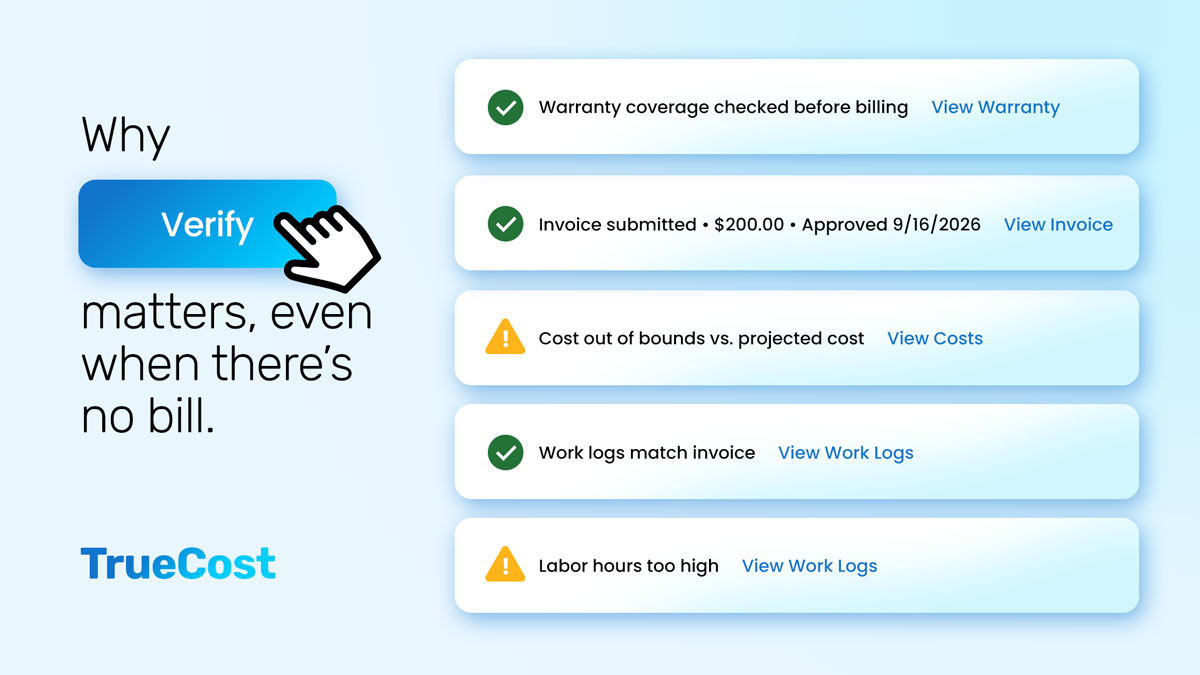
TrueCost’s Review & Verify phase gives teams a dedicated place to apply these principles before moving a Meld through billing or No Bill Needed and ultimately to Closed.
For Ops customers, MAX™ Verify provides additional support by checking work logs, photos, invoices, costs, and other repair details to surface potential issues.
But intelligence should support the review, not replace the judgment of the person responsible for it.
Your team understands the circumstances of each repair, your company’s standards, and the expectations of the owners and residents you serve. MAX Verify helps bring relevant information forward so those decisions can be made more efficiently.
As these capabilities evolve, our advice remains the same: start with clear standards, consistent accountability, and timely review.
Because a repair can be resolved without being ready to close. The goal is to make sure your team has the proof, costs, and answers it needs to confidently stand behind every completed repair.