
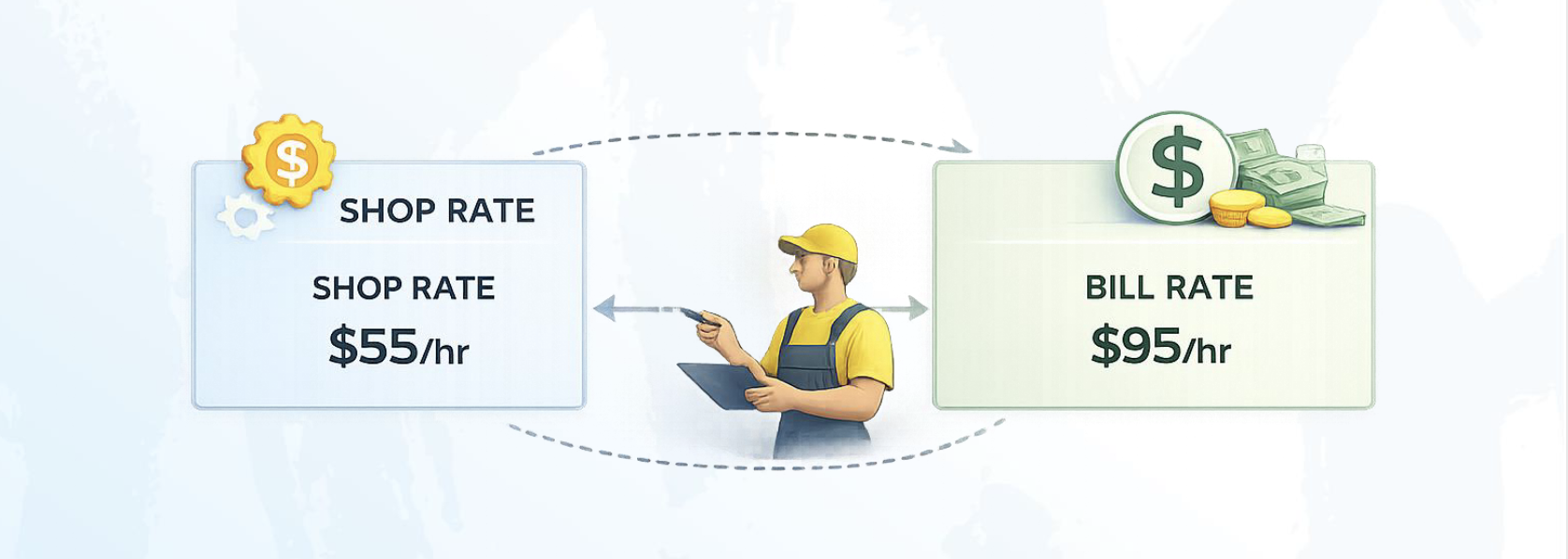
What Is a Shop Rate?
A shop rate is a fully loaded labor rate that represents the true hourly cost of having your internal team complete work. Rather than just reflecting what a technician earns per hour, a shop rate captures the broader cost of doing business and supporting that work.
Think of it as the real cost per hour your company incurs when an internal resource fulfills a Meld.
Why Actual Labor Rates Fall Short
When organizations try to assess the “cost of fulfillment” using only a technician’s hourly wage, they significantly understate the true cost of the work.
For example, even if your technician makes $X per hour, that is only the starting point. You also incur costs for:
- Payroll taxes and benefits
- Workers’ comp, liability, and other insurance
- Vehicles, fuel, tools, and maintenance
- Paid time off (vacation, sick leave, holidays)
- Training and certifications
- Software, scheduling, dispatch, and admin support
- Supervisors, managers, and leadership overhead
Ignoring these costs leads to underpricing, poor vendor comparisons, and inaccurate profitability analysis.
Best Practices for Calculating a Shop Rate
There are several ways to calculate a shop rate, but the key objective is the same:
It should reasonably reflect the total hourly cost of fulfillment, not just wages.
Below are two common approaches.
The Burden % Method (Recommended)
This is the most accurate and defensible approach. You estimate the hourly cost of each major expense category and roll them together into a single rate.
Example:
| Cost Component | Typical Range |
| Base wage | $28–35 |
| Payroll tax & benefits | $7–10 |
| Truck, fuel, tools | $8–12 |
| Insurance (WC, liability, etc.) | $5–7 |
| Scheduling, supervision, software | $5–8 |
| Fully Loaded Shop Rate | $65–75/hr |
This method forces you to acknowledge all the “invisible” costs that support frontline labor and gives leadership a much clearer picture of true fulfillment costs.
The “SWAG” Method (Quick & Dirty)
This is the simple, directional approach. You take a base wage and multiply it by 3–4 to get a rough estimate.
Example:
$25/hr × 3 = $75/hr estimated shop rate
This method is not precise, but it can be useful early on or when you need a fast approximation. Just recognize that it trades accuracy for simplicity.
How Shop Rates Help You Make Better Business Decisions
A well-calculated shop rate unlocks better decision-making across the organization:
- Improved vendor comparisons
You can objectively compare internal labor costs to vended or market rates.
- True cost visibility
Shop rates reveal the real cost of fulfillment by accounting for the entire support structure behind internal labor.
- Pricing discipline
You can price services with confidence instead of relying on gut feel or legacy pricing.
Can I Have More Than One Shop Rate?
Yes—and in many cases, you should.
A single blended rate can be too generic, especially when costs vary significantly across regions, crafts, or portfolios. Segmenting rates creates more accurate reporting and better operational decisions.
Common ways to segment shop rates include:
- By Region
Costs in Los Angeles are materially higher than in Wichita.
- By Craft or Trade
Cleaning, plumbing, HVAC, and electrical all have very different cost structures.
- By Portfolio or Asset Class
For example, lower-class properties may be serviced by junior teams, while luxury properties rely on senior technicians with higher costs.
Shop Rate vs. Bill Rate
A shop rate is an internal metric. A bill rate is what you charge customers. The relationship between the two determines margins and profitability.
Example (Time & Materials):
- Shop rate: $70/hr
- Bill rate: $150/hr
Billing 3 hours results in:
$450 revenue – $210 cost = $240 estimated profit
Even if you don’t bill time and materials, shop rates still matter.
Flat-Rate Pricing Example
Let’s say you bill Garbage Disposal Replacements at $400.
- Tech 1 completes the job in 1 hour
- $400 – $70 = $330 estimated profit
- Tech 2 (newer) takes 2.5 hours
- $400 – $175 = $225 estimated profit
Multiply this variance across hundreds or thousands of jobs and the impact becomes significant.
With accurate shop rates, your organization can:
- Identify training opportunities
- Adjust pricing intelligently
- Optimize staffing models
- Improve margins without cutting corners